Slate Roofs Manchester
Manchester Was Built on Welsh Slate — and Nothing Has Replaced It
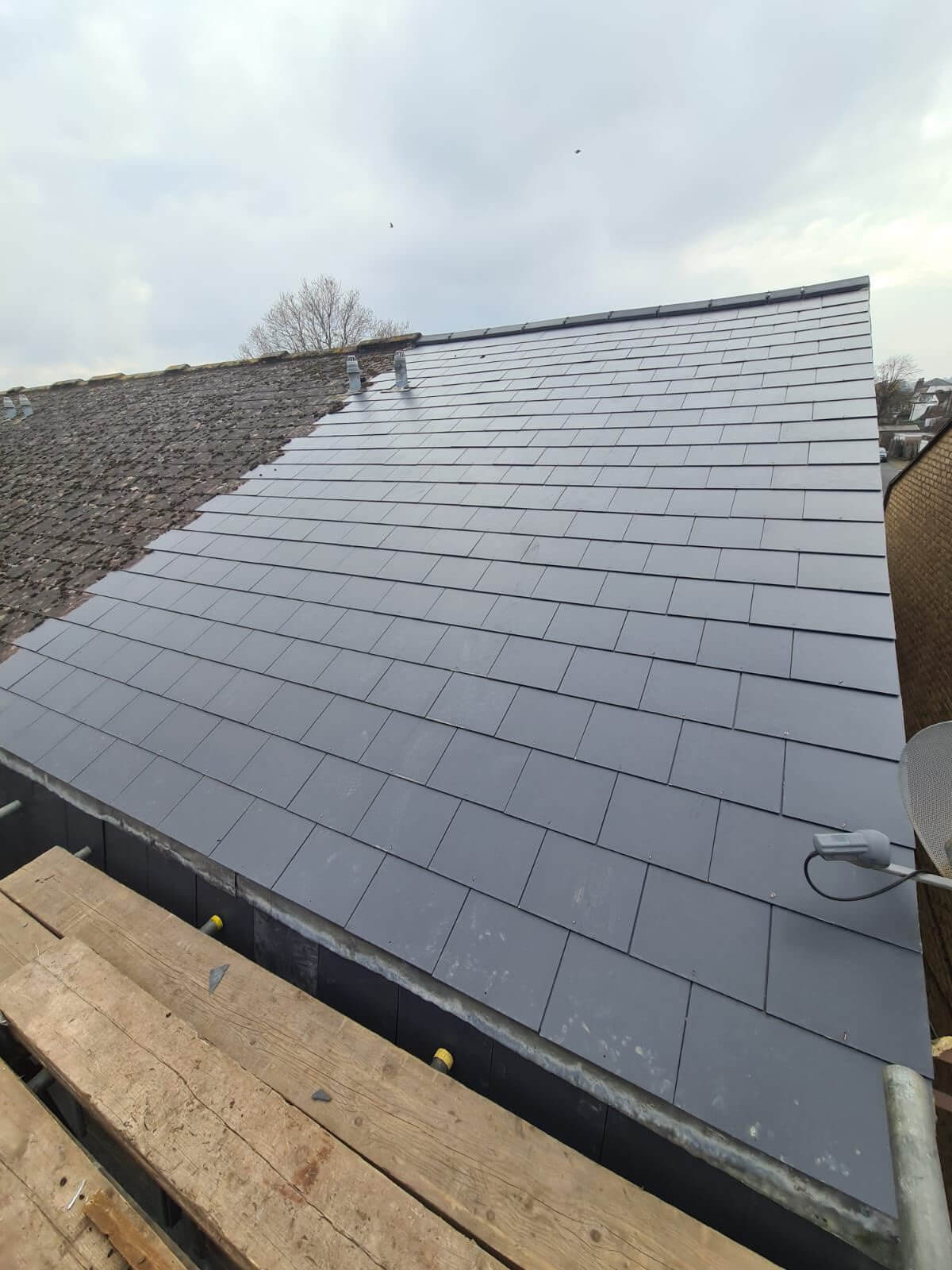
Walk down any Victorian terrace in Didsbury, Chorlton, Levenshulme, or Salford and look up. The roofs that have been there since the 1880s and 1890s — the ones still doing their job 130 years later — are natural Welsh slate. Not concrete tile. Not synthetic slate. Welsh slate, quarried from Penrhyn or Ffestiniog, hand-split and fixed onto lime mortar battens by roofers who were laying it the same way their fathers had.
That slate is, in most cases, still structurally sound. The slates themselves rarely fail. What fails is everything around them — the copper or iron nails that corrode after 80 or 100 years in Manchester's damp conditions, the timber battens that rot when moisture gets behind the felt underlay, and the felt underlay itself which on pre-1980s roofs has typically disintegrated long since. When a Victorian slate roof starts leaking, it's almost never because the slate has failed. It's because the fixings holding it in place have corroded through.
This distinction matters enormously for how the repair or replacement is approached. Guardfix Roofing & Building Ltd has been working on Manchester's slate roofs for 27 years. We carry natural Welsh slate as standard, understand the specific failure modes of this housing stock, and know how to repair, re-slate, and fully re-roof a slate property in a way that respects the material and the building it sits on. If your Victorian terrace has a slate problem, call us before anyone starts talking about replacing it with concrete tile.
Get A Quote
Natural Welsh Slate, Reclaimed Slate, or Synthetic Slate — What's the Difference and Which Is Right?
This is the decision that determines the quality, longevity, and appearance of a slate roof — and it's one that many roofers gloss over because the cheaper options have better margins.
Natural Welsh slate is the benchmark. Penrhyn and Ffestiniog slate from North Wales has been the roofing material of choice for Manchester's Victorian housing stock for 150 years, and for good reason — it's dense, low-absorption, frost-resistant, and when correctly fixed has a lifespan that exceeds 100 years. The colour weathers beautifully over time, developing the subtle blue-grey patina that defines Manchester's roofscape. On a Victorian or Edwardian terrace, it's the only material that genuinely belongs. It costs more than the alternatives upfront and the gap narrows significantly over a 30-year view.
Reclaimed slate is natural Welsh slate salvaged from demolition or re-roofing projects and resorted by size and condition. On the right job — where the budget doesn't stretch to new natural slate but the property genuinely warrants slate rather than tile — good quality reclaimed Welsh slate is a sound choice. The critical word is quality. Reclaimed slate varies enormously — sound slates from a recently stripped Victorian roof are excellent material, while weathered slate from an unknown source can be brittle, delaminating, and close to the end of its own life. We source and inspect reclaimed slate carefully and only use material we'd put on our own properties.
Synthetic slate — made from fibre cement, recycled rubber, or polymer composite — is significantly cheaper than natural or reclaimed Welsh slate and has a lifespan typically quoted at 30–50 years. On the right property it's a reasonable choice. On a Victorian terrace in Chorlton or Didsbury it looks wrong — the proportions are slightly different, the surface texture is uniform in a way that natural slate isn't, and it dates the property in a way that natural slate never does. We'll give you an honest opinion on which material suits your specific property and budget rather than defaulting to the cheapest option.
Areas We Cover
Guardfix Roofing covers all of Greater Manchester.
Whether you're in Manchester City Centre, Didsbury, Chorlton, Salford, Eccles, Worsley, Stockport, Cheadle, Bramhall, Trafford, Sale, Altrincham, Stretford, Urmston, Oldham, Chadderton, Failsworth, Rochdale, Middleton, Heywood, Bury, Radcliffe, Prestwich, Bolton, Horwich, Westhoughton, Wigan, Leigh, Atherton, Tameside, Ashton-under-Lyne, Denton, Stalybridge or anywhere in between.
We're on your doorstep. Call 07487 617146 for a free quote.

How Slate Roofs Actually Fail — and What It Means for Your Property
Understanding why your slate roof is failing is the difference between a repair that lasts and one that has you calling another roofer in three years.
Nail Sickness
The most common cause of slate roof failure on Manchester's Victorian housing stock — and the least understood. Every slate is fixed to the batten beneath it with two nails, one through each side near the head of the slate. On roofs over 80 years old, those nails — originally iron, sometimes copper — have been corroding in the damp conditions behind the slate surface for the better part of a century. When they corrode through, the slate is no longer fixed. It sits in position held only by the slates above it, but any movement — thermal expansion, wind pressure, someone walking near the roof — can dislodge it. A roof suffering widespread nail sickness doesn't fail all at once. It loses slates progressively, usually accelerating in the years after the first slates start slipping. Targeted repairs buy time but not much of it. A roof with widespread nail sickness needs re-slating — stripping completely, replacing the battens and underlay, and re-laying the slates with new stainless steel fixings.
Batten Failure
The timber battens the slates hang on are protected from the weather by the slates themselves — but not from moisture coming up from the roof space below. On properties without adequate roof void ventilation, condensation accumulates on the underside of the felt and drips onto the battens, which rot from below. You can have perfectly sound slates above sound fixings and still have a roof that's failing because the battens underneath have softened and can no longer hold a fixing under wind loading. Batten failure requires full stripping and re-battening — the slates may be reusable if they're in good condition.
Felt Underlay Failure
The bitumen felt underlay on pre-1990s roofs has a finite lifespan — typically 30 to 40 years. Once it deteriorates, it sags between the battens and in some cases falls away entirely, leaving no secondary defence against water that gets past the slate surface. Driving rain in high winds, which Manchester sees regularly between October and March, forces water up under the slate course at the eaves and ridge. With sound underlay beneath, that water drains harmlessly. With no underlay, it goes straight into the roof void. Failed underlay requires complete stripping and re-laying — there's no way to replace it without removing the slates above it.
Individual Slate Deterioration
Natural Welsh slate is extremely durable but not indestructible. High-velocity hail impact, frost damage to a slate that had a pre-existing flaw, physical impact from falling debris — all of these can crack individual slates without affecting the surrounding courses. A handful of cracked or broken slates is a straightforward repair job — we match the size and colour as closely as possible and re-fix with new stainless fixings. Widespread cracking or delamination across the whole surface indicates a material that's reached the end of its serviceable life and needs replacing.
Lead Valley and Flashing Failure
Lead valleys — the internal angles where two roof slopes meet — and lead flashings around chimney stacks and party walls are the most vulnerable points on any slate roof. Lead has a lifespan of 25–50 years depending on specification and exposure. When it fails, water tracks directly into the roof structure at the junction points rather than being shed away. Failed lead is one of the most common causes of leaks on otherwise sound Victorian slate roofs in Manchester.
Slate Roofing Services We Carry Out in Manchester
Your Slate Roofing Questions Answered
The key indicator is how widespread the problem is. If slates are slipping in one or two isolated areas, targeted repairs will hold. If slates are slipping progressively across the whole roof — particularly if multiple slates have come off in different locations over the past two or three years — that's nail sickness across the full roof, and re-slating is the only lasting solution. We'll inspect and give you a straight assessment rather than letting you spend money on repairs that won't address the underlying cause.
Often yes. Natural Welsh slate doesn't degrade the way other roofing materials do — the slate itself is frequently still sound even when the nails and battens holding it have failed. We sort stripped slates on site, removing any that are cracked, delaminating, or below a usable thickness, and reuse the sound material. Reusing original slates reduces the cost of the re-slate and maintains the character of the roof — original Welsh slate from the 1890s has a colour and texture that new slate takes years to match.
Welsh slate — particularly Penrhyn Blue and Ffestiniog — is denser, lower absorption, and more frost-resistant than Chinese slate, which has become the dominant cheap alternative in the UK roofing market over the past 20 years. Chinese slate has a significantly higher water absorption rate, which in Manchester's climate means it's more vulnerable to frost damage and tends to delaminate within 20–30 years. We use Welsh slate as our standard specification on Manchester properties. We'll tell you if we're using anything else and explain why.
A full re-slate on a standard three-bedroom terrace typically takes three to five days, depending on roof size, pitch, and the condition of the rafters once the old roof is stripped. We don't rush slate work — the fixing detail and head lap that make a slate roof last don't allow for shortcuts.
We match as closely as possible. Natural Welsh slate varies in colour from blue-grey to grey-green depending on the quarry and the age of the material — an exact match to 130-year-old slate isn't always achievable with new material. Where a close visual match is important, we look at reclaimed Welsh slate from demolition projects which has often weathered to a similar colour to the existing roof.
Not without proper roofing boards or crawling boards spread across multiple slates. Slate is brittle and the fixings are at the head of each slate — concentrated weight at the tail of a slate cracks it across the fixing holes. Any inspection or maintenance work on a slate roof should only be carried out by experienced roofers with the correct access equipment. Walking on a slate roof without proper protection causes more damage than most of the problems it's intended to inspect.
Any Questions?
Ask Us
More Roofing Services We Offer In Manchester
From a single slipped slate to a full roof replacement — we're the Manchester Roofers that handle every roofing job across Greater Manchester. 27 years in the trade means no guesswork, no unnecessary work, and no nasty surprises on the bill.


Get a Free Slate Roof Inspection in Manchester
Slates slipping, a leak you can't trace, or a Victorian roof that's overdue for inspection? Call Guardfix for a free assessment from roofers who understand natural slate and Manchester's housing stock.